The Space @ Surgeon’s Hall
Until August 23rd (10.30)
Some plays are born of the intellect, & some are dragg’d out from the guts of one’s existence,. ‘The Lost Priest’ in gestaation firmly fermented in the latter camp as the younger Gabe Seplow (he’s still young by the way) struggl’d with his faith, his place in that faith, the importances of cultural identity & his personal self worth & identity.
Gabe is a Bostonite, & proud founding member of Orchard Theatre Company, a personal statement on whose website reads;
As a theatremaker, I strive to create works that challenge standards, provoke exploration of the human experience, and ignite emotions. I reject the confines of convention, embracing innovation and experimentation as essential instruments in creation. The theatre I make is a theatre that holds a space for a mosaic of diverse voices to converge to authentically mirror the tapestry of humankind. I seek to inspire empathy, spark dialogue, and leave an indelible imprint on the collective consciousness, moving the boundaries of the theatrical experience and reaffirming the enduring power of live performance.
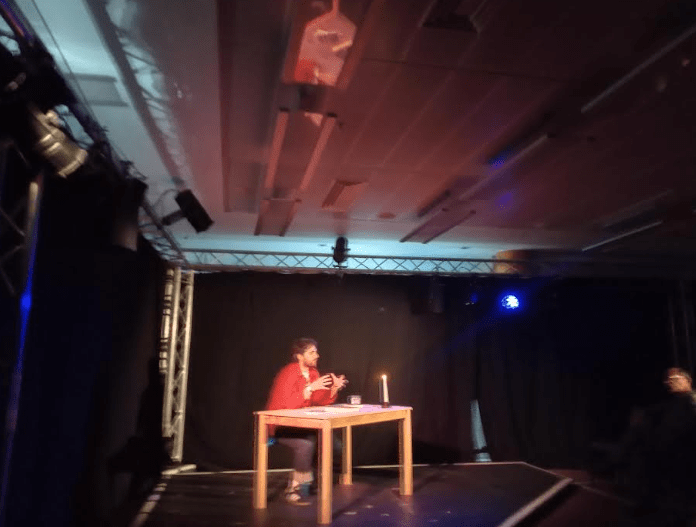
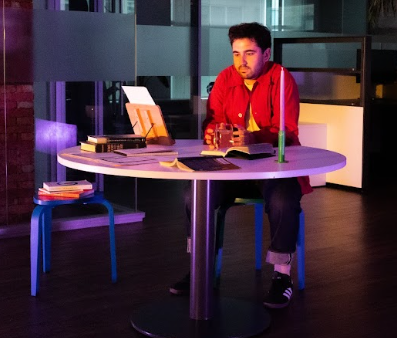
So, what about Gabe’s ‘The Lost Priest’, currently appearing in a morning, ‘just-finish’d-my-coffee-&-I’m-proper-ready-for-the-day,’ timeslot. Well, this play is not an actor & his script, but a creative intertwining of the two – a highly charg’d & introspective one-man play. The action is set about a table laid out with a candle & two books – the Merchant of Venice – whose Shylock, the money-lending Jew, will be making an appearance-; and a book of American legends.

Faith is stagnation, dogma in the doghouse, & a monologue that is occasionally monotone, – perhaps ‘The Lost Priest’ could have done with a little vigour, a spot of animation – but it is what it is – a very fine piece finely acted. What was once profound religious writing has now become incomprehensible hieroglyphics; the rituals of Judaism now nothing more than distant gimmickeries. We also get the feeling that Gabe’s personal battle is a mirror image to that of society in general today – of belonging & estrangement, of individuality & the clan.
I chatted briefly to Gabe after the play, asking him about the genesis of ‘The Lost Priest.’ His response was something along the lines of the piece beginning being about a fictional character, but in no time at all he had realis’d there was more & more of his personal anima immersing itself in the tale. As everything the young Gabe knows & understands about Judaism begins to sour & spoil, he takes us on a highly personal journey thro’ his doctrinate struggles & self-remonstrations. His performance is emotional, insightful, thoughtful, & – most importantly – watchable.
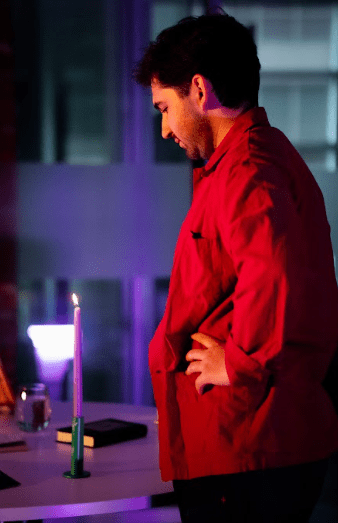
Gabe’s acting is so calm, so acute, I wouldn’t mind what he was going on, to tell you the truth. Unfortunately religious doubts are as old as the religions themselves, & for an agnostic as I am, it renders such a quality piece as something of a fairy tale. I do understand, however, & as Gabe does indicate, that the Jewish devotees have had it pretty hard throughout history, which added to the general confusion & dislocations of identity as experienc’d by the growing Gabe.
Still, it certainly feels like doing this play has brought the performing conscience of Gabe onto a higher level, some might even say celestial. Rather like Keats jumping in at the deep end thro’ his composition of Endymion, to examine the shallows & rocks & pools of his art, getting certain somethings out of his creative system to carve the bedrock for the Odes & the Hyperions to come.
Damo


 themumble.uk