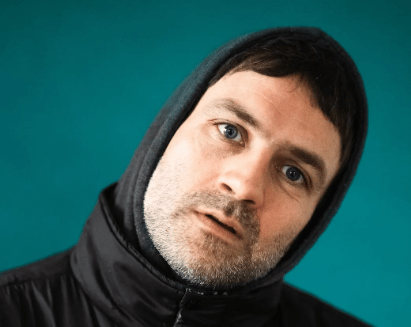
A boundary-pushing experimental comedy show is about to hit the Fringe. The Mumble got the inside track…
Hello Loz, so where are you from & where do you reside these days?
Both me, Lawrence, and my alter-ego / younger self / character of the show (though everyone just assumes he’s me so maybe I should just drop that clearly confusing detail) Loz, are from a village called Bishops Cleeve in Gloucestershire.
What first got you into the performing arts?
I think it all began with having a narcissistic father who didn’t give me the space to develop a solid sense of self-worth, so I sought to find this through people-pleasing outside of the family unit, which led to developing a certain capacity for humour, and the next thing I knew i was taking a show to Edinburgh.
Who inspired you artistically, growing up?
I’m inspired artistically by the reckless abandon of the wind, the freedom of the wiley cat, and the transformational acting skills of male friends who can pretend to be empaths when around women.
I’m particularly stirred by artists who are able to persevere and own their unique perspective regardless of the conventions of form, and who are capable of revealing a deeper truth to the nature of what we think is real. For the show, i’ve been inspired by the presence, shared joy and collectivity of Julia Masli’s Ha Ha Ha Ha Ha Ha Ha, Jordan Brookes’ capacity to delve deep into our strange human lives whilst keeping it funny and light somehow, & the playful absurdity of John Norris’ show Mr Chonkers.
How would you describe your performance art?
Ideally, I wouldn’t. But if I had to, I would say that I am trying to explore the quality of experience that defines our contemporary moment, that at once feels scattered, distracted, dislocated, narcissistic, delusional & surreal, whilst also being punctuated with moments of depth, clarity & connection that point to something beyond a reality that we’ve come to identify ourselves with despite it driving us insane. But like I say, I’d rather not.
There are elements of clown in the show. I’m drawn to elements of clowning because I think there is an anarachic spirit to it that invites openness and intimacy, whilst also revealing the absurdity of the conventions that we often unconsciously abide by. There’s something about leaving our adult, rational, protected selves at the door that I think can be disruptive in a playful way.
Can you tell us about your training?
I have a horticulture level two diploma that I haven’t yet put to use, a degree in Anthropology that has so far not once been referred to as a reason for my recruitment to a role, & I’ve never been to Gaullier.
You’ve got a deep religious sentiment, could you tell us about it?
I had a transcendent experience at the age of 20 whilst looking out the window of my flat, caffeinated up to my eyeballs, realising that all form is empty, reality is a construction of the mind, and all worldly aspirations are mere obstacles to a deeper quest for meaning and truth. Unfortunately, I’ve been unemployed, on and off, ever since. I’m a Buddhist in training and try my best to live the principles of Buddhism, with little slip ups along the way, like lying about my age to casting agents and women.
You’re bringing a show to this year’s Edinburgh Fringe, what’s the craich?
Oh its guna totally fuck with the comedy landsape. Before me, people thought they needed to write jokes and have material and a narrative arc, but I think what my work demonstrates is that you really just need to believe in your own story of who you are and what you’re capable of, and you can do anything you set your mind to, badly.
Where, when, how & why did you first get the idea for the This Can’t Be It?
I think i’ve wanted to express something I wasn’t seeing on stage. I was always struck at how much of stand up exists in a space of identity, pop culture, cynicism & certainty and I wanted to do something that felt more consistent with the way the world appears to me – unknowable, confusing, overwhelming, beautiful.
Can you describe the writing process, from start to ‘ready to perform’?
I started the process by booking open mics and going along with no material at all. I’d give myself a rule, so for example, the rule of “the show will never begin” and then playing in that space. The more I did this, the more I found beats that were interesting, which I gradually built into a longer piece. I think the show still has this kind of open-ended quality that was established in those early gigs. I never know exactly what I’ll do in the show, but there are bits that I can explore that have worked previously, if it feels appropriate.
What are the key themes of the show?
I guess there’s this quality of a life never really beginning that I’ve wanted to explore. I always have this feeling of life kind of slipping through my fingers, as if I’m constantly trying to find ways to keep myself at a distance from what’s real. This leaves me feeling like there is a reality that I’m in some way divorced from, that I’m constantly In a struggle to make contact with.
I often wonder how it would feel to arrive at the end of your life and think “What even was that?!”, so I’m interested in exploring being comfortable in uncertainty. My show is predominantly improvised, and it excites me to explore what happens when I hold the show very loosely so that it can respond and adapt to the conditions of the room, and create a space where we can be open to finding connection and meaning together in something that might feel like its empty or directionless.
You’ve performed the show this year at Leicester Comedy Festival, Glasgow International Comedy Festival and the Brighton Fringe – how has it evolved as you’ve gone on?
I started taking the show to festivals with my tech/producer Rachel Goldsby & friend/clown Lucy Ellis. To begin with, it was a couple of ideas and a lot of improvisation, but I found just being on a stage for a longer period than I was used to really useful in developing a sense of how a show should feel in my body, and what the rhythm of the show should be. Also, knowing how it feels to perform for an hour in front of people who are just there to eat ribs (in the case of Glasgow), or in front of door staff & a sound technician (Leicester) was a good experience in building resilience and perseverance as a performer.
Can you sum up ‘This Can’t Be It’ in a single word?
Aversion.
What else will you be up to in Edinburgh when you’re not performing or promoting your show?
I’m going to go the sauna and make sure I don’t totally lose my mind, and I’ll see alot of stuff. I’m seeing it as a creative period to further flesh out my show, so I want to be reflecting and writing new bits whilst I’m there, rather than breaking my balls trying to perform constantly. I decided to do this work to bring more joy into my life, so I’m very keen to find a way to have fun and not in any way stress myself out whilst doing what I love.
What will Loz Dodd & This Can’t Be It be doing for the rest of 2025?
I’ll be looking after little old Lozzy, don’t you worry about that. As far as the show goes, I’m booked for Lambeth Fringe, Birmingham Fringe and Barcelona Fringe later this year, with the aim to come to Edinburgh next year for a full run.
Loz Dodd: This Can’t Be It
Bar 50, Cowgate
Aug 10-19th (14:30)
 themumble.uk