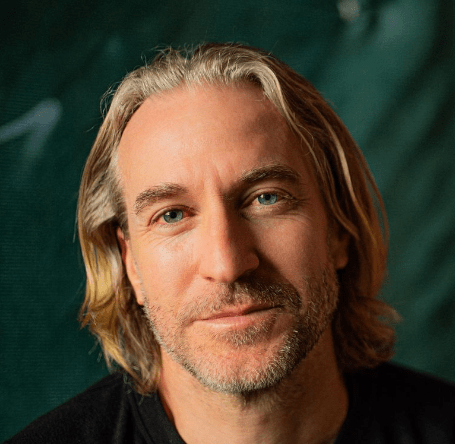
This Fringe, a lone actor is on a mission
To help us reclaim our emotional truth
Hello, so where are you from & where do you reside these days?
Hi there. I’m originally from New York and Los Angeles. Currently, I live in Edinburgh.
What first got you into the performing arts?
I needed an outlet. The household I grew up in was volatile, despite my parents’ love. Tension hung thick in the air, with fear and unpredictability everywhere. Losing myself in that world gave me both safety and strength. It became my way to reclaim my voice.
Who inspired you artistically, growing up?
River Phoenix, Anthony Hopkins, Oliver Stone, Black Thought, Q-Tip, Big Daddy Kane, Kool G Rap, Ice Cube, Brand Nubian, Mobb Deep, Pete Rock, Thom Yorke, Henry Miller, Sidney Lumet,Kathryn Bigelow, Robert Downey Jr., Chris Cornell, Daniel Johns, Joan Allen, Jessica Lange,Eldridge Cleaver, Steve Martin, Robin Williams, Peter Sellers, Beth Gibbons, Lisa Gerrard, JamesLavelle, Jackson Pollock, Seal, Frédéric Chopin, Marlon Brando, David Bowie, Ernest Hemingway,Franz Kafka, Samuel Beckett, Kahlil Gibran, Gregory David Roberts, Paul Bowles, Jim Carroll,Jerry Cantrell, Hope Sandoval, Edvard Munch, Spalding Gray, Gus Van Sant, Larry Clark, Lucian Freud, Francis Bacon, Elliott Smith, Jeff Buckley, Sia, Fiona Apple, Nan Goldin — among others.
You’re a filmmaker, yeah? Can you tell us about that?
High school was brutal. I was a loner—couldn’t fit in. I spent hours at the local video store, waiting for new releases. Films became my escape, my education, and my closest companions. Oliver Stone’s Platoon had the biggest impact on me—visceral, raw, stripped of any slick veneer. To me, it remains the greatest war film ever made. Every performance hits a nerve.
Hollywood Shuffle, directed by Robert Townsend, was a strong second for its unapologetic satire on exploitation in Hollywood. Townsend financed nearly the entire film himself, charging production costs across multiple personal credit cards—an almost unthinkable move at the time. His boldresourcefulness and refusal to wait for permission embodied the struggle of an artist determined to be heard on their terms. Those two films were lightning bolts—I took them in like gospel.
When I attended NYU, I dove in deeper—camping out in the Bobst Library, exploring the film archives, and scavenging rare titles at Kim’s Video in the East Village. That chapter opened a door to the world’s great auteurs. Around the same time, I landed an acting role on Broadway. Balancing my studies and the stage became overwhelming—I fell behind and got lost. Fifteen years later, I re-entered film school in L.A. and finally rekindled the pursuit.
But there’s also an actor in you. What’s the story, and how do you balance the two?
River Phoenix moved me more deeply than any other actor. He was exquisitely pure to the camera, and when I saw him in Stand By Me, I knew I had to act. I was twelve. His death rocked me. That same year, I landed the lead in a feature and thought I was on track — but life had other plans. I found myself pulled toward theatre directing, which eventually led to film directing.
I put acting on hold for a long time — not from lack of love, but to learn how to bring my stories to life. During that period, I focused on honing my writing and producing skills. Yet, through it all, the fire to act never went out. Now, I balance both by letting each feed the other: directing and writing deepen my understanding as an actor, and acting fuels my passion for storytelling. All that struggle, pain, and learning — it’s all fuel.
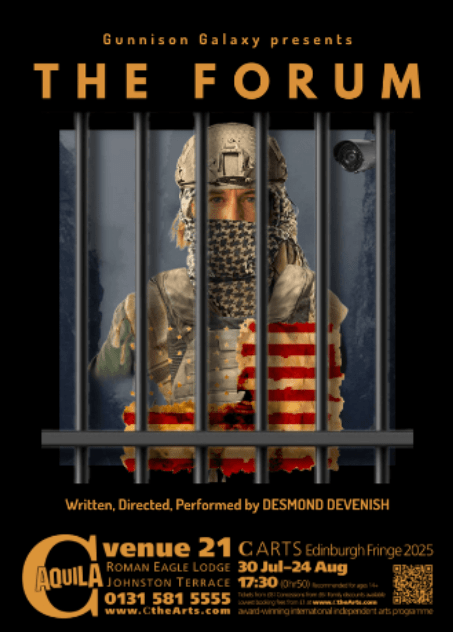
You’re debuting a show at this year’s Edinburgh Fringe. Can you tell us all about it?
This piece is about guilt and the deep wounds caused by living under systems indifferent to human well-being. I’ve had to find meaning through artists, thinkers, and personal growth, while many in power focus on making tech more addictive instead of helping people live with self-possession.
THE FORUM is a response to that. It’s meant to disrupt passive despair. It’s not safe, and it’s not meant to be. It’s a ritual, a provocation, a rallying cry. At the heart of the show is Killian Hitchens — a young man who starts out wanting to heal others but becomes a militant revolutionary. The audience becomes the tribunal—witnesses to his fall, redemption, and transformation. In this era of post-COVID isolation, AI saturation, and spiritual fatigue, THE FORUM is a call to feel deeply again. To be raw. To purge. To say, “I don’t know what the fuck is going on,” but know we have each other’s back. This piece is about reclaiming our sovereignty and emotional truth.
With audience participation being such a big part, how reliant are you on them? Do you hope they’ll be on board each night?
I’m ready for whatever comes. The audience is essential — a vital part of the engine. If they resist me, I’ll use that tension. If they engage and lean in, we’ll ascend together. If no one engages, I’ll turn that silence into my trial, my reckoning, and my measure.
Where, when, and how did you first get the idea for the show?
The first seeds were planted in 2009 with a writing partner, post-financial crash. The world was spinning—bank bailouts, Occupy, the rise of smartphones and social media, the surge of disinformation and polarization. Wars were ongoing, and trust in systems was eroding. That period sparked an idea for a film about a schoolteacher joining an underground resistance.
That film never got made, but the themes stuck. Ten years later, I started shaping a new story with another writing partner — about a reclusive, ex-soldier-turned-messianic figure. Eventually, I merged both ideas and characters into Killian Hitchens and worked on it by myself.
After January 6 {the attack on the Capitol in Washington}, I knew I had to tell this story. But I’m careful not to align with any particular ideology. The truth is, chaos and delusion have infected every side. People continue chasing illusions and rewriting reality. This show is about pushing back against that fog.
Can you sum up your show in a single sentence?
THE FORUM is walking straight into your fears and loving the enemy with all you’ve got.
What else will you be up to in Edinburgh when you’re not performing or promoting your show?
Promoting other artists’ work. I’m deeply grateful to be here with fellow creators. I want this to be a great festival for all of us. And if I find a moment to pause, I’ll be lying in the grass somewhere, soaking up Edinburgh’s greenery and beauty.
What’s next for you after the Fringe?
I want to take THE FORUM on the road — tour it to other cities and countries, collaborate with musicians, visual artists, technicians, and continue evolving it in response to the world. I’m also developing a couple of film and series projects and hope to mentor young artists who are justfinding their voices.
THE FORUM
C Aquila (studio),
Roman Eagle Lodge,
July 30 – August 24 (17:30)
 themumble.uk