C aquila – temple
Aug 5-11, 13-18, 20-25
11:30
When Shakespeare accompanied William Stanley to Italy in 1585-86, he witness’d an art form that would revolutionise the English stage – an entity that is now slap bang at the top of the Royal Mile in Edinburgh this Fringe
A couple of days ago, at the C Venues launch party, a snippet-centric cornucopia of international flavors & treats, & witness’d something I thought I never would, slept on it, & set determin’d to see the full thing. But first, the back story.
There is a certain corner of academia dedicated to the invalidation of Shakespeare as, well, Shakespeare. They ruminate on him being too poor to gain the incise details of continental Europe, & of Italy especially. Another bone of contention is the lack of university training from a vastly superior intelligence which could never have been wrought from the son of a shoemaker in some rural Warwickshire backwater. Of course it is university-trained ‘wits’ who say this.
However, I turn a pretty good phrase myself, despite dropping out of higher education with drugs-fueled rapidity. So Shakespeare could have been Shakespeare after all, & a few years ago I attack’d the problem with an Agatha Christie style passion, gaining some rather interesting results. The general idea is that Shakespeare accompanied the future earl of Derby, William Stanley, on a tour of Europe 1585-87.
Like all art, poetry grows naturally out of accumulated materielle, to which is added an individual poet’s personality & technique. Their creations should be seen as the fragrant flowers of a bush, the roots of which are buried deep under the earth. By following these roots to their sources of nourishment, we can slowly create a picture of the poet’s unseen life, the one that lives beneath the surface of the page. If Shakespeare had accompanied Stanley, the sheer wealth of scenery & culture that Europe contains should have found an eventual memorial among his plays.
Superimposing Stanley’s travels of Shakespeare’s continental locations provided a perfect fit, the sonnets to the handsome youth have been proved, via Richard Barnfield’s own sonnets, to be dedicated to Stanlet – there’s even an amorous ‘Dark Lady’ who turns up in Istanbul.

What all this means is that Shakespeare was in Italy with Stanley, & in all likelihood, studied together in Padua. Forty years earlier, in 1545, a troupe of communally-funded traveling performers of the new-fangl’d ‘commedia erudite,’ went to a notary office in Padua to make their existence official. The theatrical tradition was about to explode into Europe, & by the end of the century permanent playhouses were springing up all across the continent, the earliest of which were in Shakespeare’s London, which I am convinced was inspired by Shakespeare witnessing the Commedia plays first-hand, including the masked Commedia dell’arte offshoots. Indeed, two of Shakespeare’s earliest plays, Love’s Labours Lost & Twelfth Night, possess striking Italian influences. Chief among these is the ‘confusing twins’ plot of Gl’Ingannati (the deceived), one of the commedia erudita of the Italian Cinquecento. The diarist John Manningham noted similarities in his diary record of a performance in 1602, when it was, he wrote, ‘most like and neere to that Italian called Inganni’.
& so, to the 2024 ressuraction ! What a delight! I’d only seen the costumes in oversize books, secretly dreaming I’d love to have seen a CDA show in real life – but now it was happening before me – in English AND Italian. Even the phrase, Commedia dell’arte sends a shiver down my spine, just as the word ‘attreversiamo’ exotically-excited Eat Pray Love’s authoress, Elizabeth Gilbert.
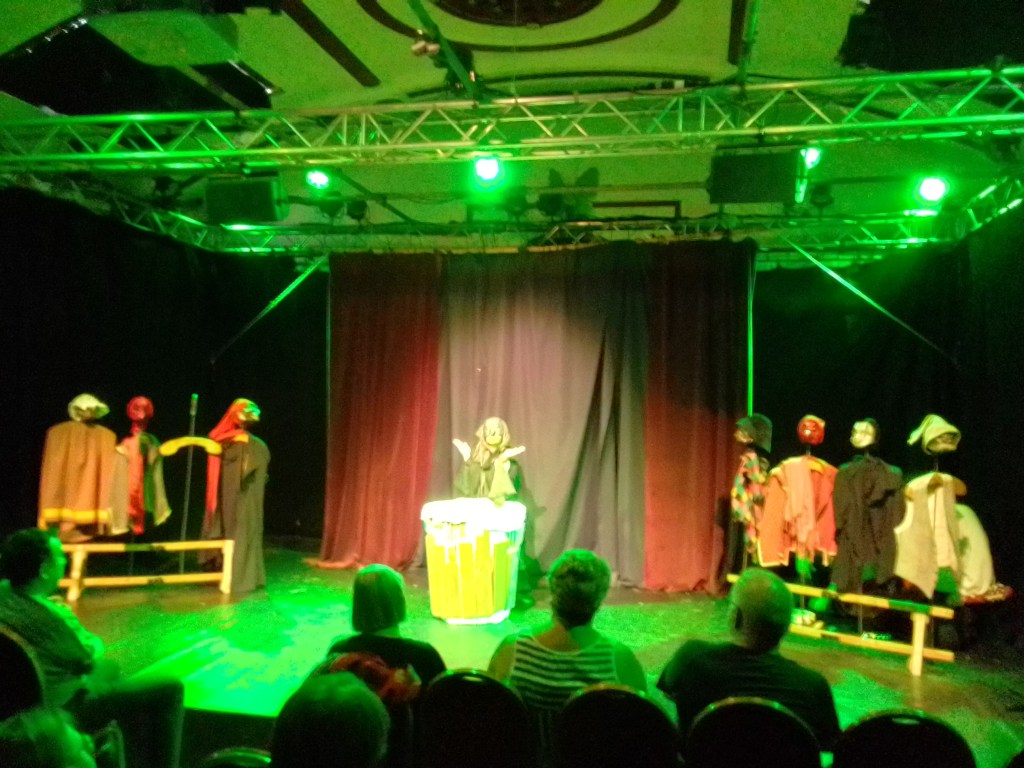
At its core, Masquerade Mask is a showcase for each of the stock ‘avatars’ that constitute CDA, whose masks & costumes are donn’d by the three excellent actors – Luca Comastri, Tania Passarini, Gabriel Bird – of the ’Fraternal Compagnia’ company from Bologna. The avatars include the servants Zanni and Arlecchino, the Doctor; the Captains & a brilliant contest between Death & the old Venetian merchant, Pantalone. Along the way they extract groans & happy aahs from the audience, which is a sign of a professional ability to form a consummate connection with an audience. This is top-level theater, despite the buffoonery.
There’s music, too, like songbirds occasionally chirping along to a cathedral organ. Yeah, it was great, & with the costumes & masks hanging on rails on the stage itself, I really did feel like I’d time-warp’d to some Italian piazza watching CDA in its true heyday. The art form engages with some really deep, primal fibers of humanity, that are charmed into chiming life by the spectacle. I am VERY happy I went to see Masquerade Mask, in which centuries of history were condens’d perfectly into the length of a standard Fringe Show – I mean literally, perfectly, as experiencing those 50 minutes felt like listening to one of the classic rock & Roll albums of our times.
Damo


 themumble.uk